Rubik's Cube Formula Reference (3x3)
A compact reference for 3x3 notation and the most common algorithms used in the beginner layer-by-layer method and CFOP. Chinese version: 常用公式表.
Notation
| Symbol | Meaning |
|---|---|
U D L R F B | Turn the Up / Down / Left / Right / Front / Back face 90° clockwise, seen from that face |
U' | Same face, 90° counterclockwise |
U2 | 180° (either direction, same result) |
M | Middle slice between L and R, turned like L |
E | Middle slice between U and D, turned like D |
S | Middle slice between F and B, turned like F |
x y z | Rotate the whole cube like R / U / F |
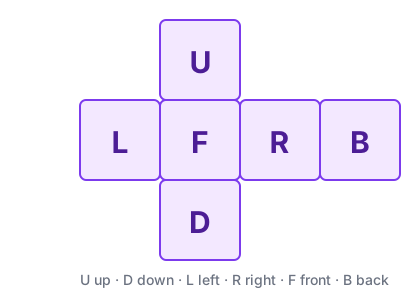
The unfolded cube
The six faces in a standard unfolded layout: U on top, L F R B in the middle row, D at the bottom. Everything in the table above is relative to this orientation.
Core triggers
| Name | Algorithm | What it does |
|---|---|---|
| Right insert | R U R' U' | Inserts a corner (right slot) |
| Left insert | L' U' L U | Inserts a corner (left slot) |
| Front trigger | F R U R' U' F' | Orients the top cross on the last layer |
| Sune | R U R' U R U2 R' | Orients the last-layer corners |
| T-perm | R U R' U' R' F R2 U' R' U' R U R' F' | Swaps two adjacent corners and two edges |
These are the building blocks most beginner and CFOP formulas are made of. Learn them as muscle memory first, then combine.
Beginner method, step by step
| Step | Goal | Notes |
|---|---|---|
| 1 | White cross | Solve by inspection, not by algorithm |
| 2 | First-layer corners | Repeat the right insert until the corner drops in |
| 3 | Middle-layer edges | Right: U R U' R' U' F' U F; left: mirror it |
| 4 | Top cross | F R U R' U' F' until the cross is oriented |
| 5 | Top corners (position) | Use the corner-permuting algorithm for each unsolved case |
| 6 | Top corners (orientation) | Repeat R' D' R D holding the corner in the front-right |
| 7 | Top edges (permutation) | Cycle the remaining edges with the standard edge cycle |
CFOP overview
| Stage | Meaning | Why it is faster |
|---|---|---|
| Cross | Solve the first-layer cross | Done mostly by planning |
| F2L | First two layers | Pairs are solved together instead of one at a time |
| OLL | Orient last layer | One look instead of several |
| PLL | Permute last layer | One look instead of several |
CFOP is not "faster layer-by-layer" — it is a different way of thinking. Transition gradually: F2L first, then OLL cases, then PLL cases.
Caveats
Wrong notation is the most common reason an algorithm "does not work". Double-check the face order and turn direction before blaming the formula, and try it on a solved cube first.